Engine in the car prior to Bill removing it.

Main bearings when they pulled the pan.

Tear down and engine pull.

Pictures that Tom sent me from when he first restored the car 50 years ago.

Latest update from Bill:
I hope everyone is doing well? I have finally had time to get started on Tom's Stearns again. I made a oil pump drive shaft out of 1/2" rod but only got 12 psi. This really concerned me. Then I saw that oil was gushing inside the distributor drive hole, almost coming out. So I added a bushing at the bottom and machined it to the oil pump driveshaft size. I guess Knight used that to seal the oil pump. That increased the pressure to 25 psi, but you could still see oil swirling out of the pump drive. Then I added a second bushing to completely match the original drive only without a gear so it could spin, it is 32" overall length. Oil pressure jumped to 80psi immediately, then after backing the pressure adjuster of a couple rounds we got it down to 60psi. The left gauge is plumbed from the restricted feed for the timing chains, that is why it is a couple pounds lower than the right gauge which is hooked up to the original oil pressure gauge port. We will see how much that affects actual pressure later. This was at approximately 675 distributor RPM or 1350 engine RPM. Moving the throttle valve/flow regulator didn't seem to affect the pressure at all? It was getting late so we will play with adjusting that and checking for positive sleeve oiling tomorrow.

Response to Bill from Ed.
Several comments........I would start the car using SAE30 and after twenty minutes drain it and run SAE40. After an hour of running I would go to SAE50. All straight viscosity. I set up AJ's car to have 20lbs at idle when HOT. AJ's car seemed to build pressure easily, and I only messed with the throttle adjustment. Try could easily hear mechanical noise when the pressure was below 10psi. When I first had the car it was set to run very high. I set the adjustment to where the factory said to start and it had only 3psi at idle cold. A little adjustment goes a LONG way. I would set it to run on the high side at first.......that motor is probably tight, and there is risk of lock up. Also, I would run a cold water stream into the block and force the engine to run as cold as possible for the first half hour. Oil's primary function is to remove heat first, and lubricate second. I thing if the engine was set up loose it will be fine. If things are tight, who knows what will happen. Running the cold water will heal things break in faster, and possibly prevent any early clearance issues. I would probably have only put a few bolts in the oil pan as I could easily drop it and look for babbitt or any other issues. I often don't even run a pan gasket for the first hour of break in.......to make things easier to inspect. Be sure it's not running lean as soon as the engine runs and is stabilized. Take a video of the start up and post it please. Best of luck, Ed.


Bill has the engine running on a stand now.

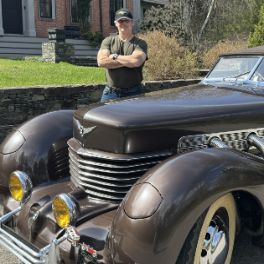
Engine is back in the car and they are driving. Report from Bill: Drove Tom’s Stearns again today. We have worked on some door alignment/hinge issues. Played with the timing, found a plug wire out of the cap and arcing after the first test drive. It ran smoothly and more powerful this time. Ran 55+ easily. It has some transmission noise in 1st gear that I didn’t notice without the muffler and tailpipe. So I guess we will look into that next.
To join in the conversation, you must be a club member.
You’re welcome to read and like every post. Members can reply and start topics of their own.